Travel, food & life....as it happens

Showing posts with label Sports. Show all posts

Sunday, April 7, 2013

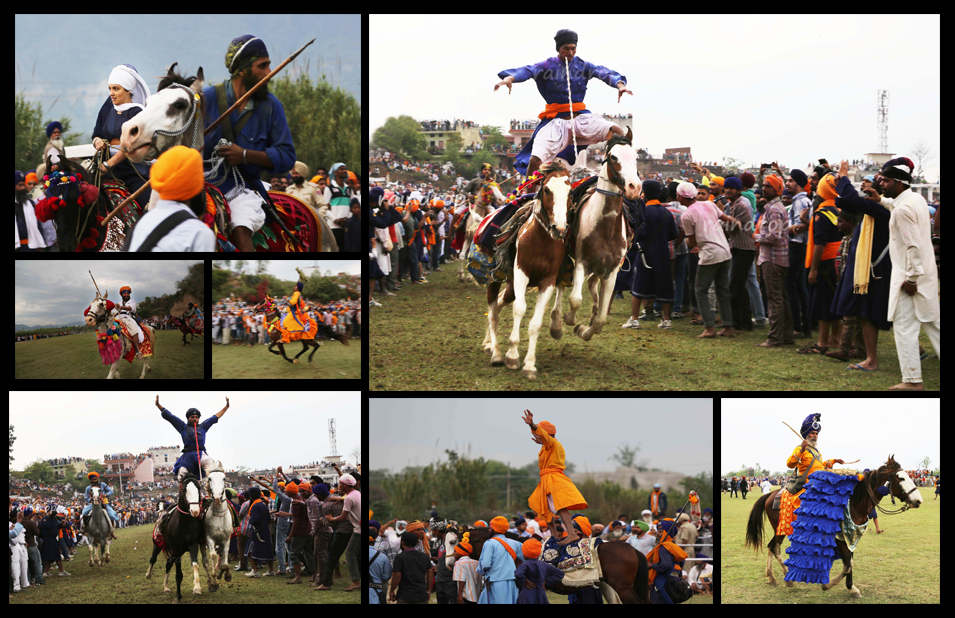
Hola Mohalla @ Anandpur Sahib, Punjab

Hola Mohalla is a Sikh sporting event held every year in a public arena near Holagarh Fort close to a small river named Charan Ganga in the holy city of Anandpur Sahib in Punjab, India.

Warrior Nihangs celebrate it a day after the Holi festival to demonstrate ancient sports and martial art skills in simulated battles and competitions.

The image of the Gatka-Chakar (circular device for deflecting weapons) you see here is something that I had seen in a Hindi movie in 2006. I was fascinated but had no clue what it was. This year I saw another image of it and followed the deep trails and trenches of internet hyperlinks to figure our that they were a part of a bigger festival. In a matter of three days tickets were booked, arrangements were made and I landed up in Punjab last week to see Hola Mohalla 2013. It is also popularly called the 'Sikh Olympics'.

Gatka Chakar - Hola Mohalla 2013


This was not the first time I was visiting a Gurdwara (Sikh Temple). I have always been amazed by its cleanliness, crowd control and lack of any beggars around. A prayer is called an 'ardaas' in Punjabi. I had gone to pray for a friend. I am not a firm believer of rituals but I do believe in the power of faith in the beyond. There is something beautiful about placing unconditional trust in something. It calms one down.

'Nihangs' are warrior Sikhs who carry forward the legacy of ancient warfare and are martial arts experts of  combat techniques of the bygone era. In today's world it is purely ceremonial and is exhibited only during festivals or special occasional. Activities related to their military and wartime prowess is called Gatka Art. It includes horsemanship, sword/stick fights, use of quoits/daggers/aquatics/archery etc. 

Anywhere in the world, combat sports come with a baggage of aggressiveness. But here, I found them to be serene, focused and determined. Most of them wore blues, whites, blacks and orange.

The street procession is called nagar-kirtan where they display their mastery and head towards the stadium where formal competition takes place.

I did not see many corporate banners or FMCG stalls in the area. I come from an advertising background but it always makes me very happy to see the lack of their presence as well. Untouched by commercialism is an aspect which you find far and few. This is one such place. Raw, rustic, unadulterated and pure in its form and talent. Both men and women.


You can stay there in Gurdwara rooms by the SGPC or hotels. Another alternative is to stay in Nangal of the Bhakra-Nangal Dam fame which is nearby. Silly me, I realised now, after decades, that Bhakra and Nangal are two separate dams, not a single one.You should keep at least three days if you want to see famous places nearby. One full day for Hola. One for visiting Anandpur & Kiratpur Sahib Gurdwara (preferably the day after Hola). One for the Brahma Temple,Naina Devi & Bhakra. The Bhakra Dam is a must see. It is one of the highest gravity dams in the world. The pride of India - Its work started in 1948 and was completed in 1963. Withing budget and within time! The Satluj Sadan on bank of Govindsagar reservoir at Nangal is where the Panchsheel treaty of peaceful co-existence was discussed by the then Indian prime minister Pt. Jawahar lal Nehru and his Chinese counterpart H. E. Chou-En- Lai on April 28th 1954.

Satluj Sadan by Govindsagar Lake - Nangal, Punjab


Monday, October 29, 2012

Hu tu tu tu tu....

It all began with fist fights at home.
Then the school level. One class played against the other.
Then came the interschools.
Then the Cluster meets.
Then the Zonal competitions.
Then Regional Meets.
And finally the National camp & championships.

Most parents would have been proud to let their child go for the National level sports meets.
But not those of the ones who played the rustic sport of 'Kabaddi'.
At least not in the 1980s.

Mainly for 3 reasons-

1. Kho-kho & Kabaddi were rural cousins of other high profile games. To be played just to be physically fit. They had no future in terms of gainful employment. 'Lawn-Tennis' & Cricket were the sports of repute.

2. They were not 'lady-like' games. Breaking a bone while playing was very common. If you were not heroic enough to break one, at least a joint dislocation or cuts n bruises were assured of.

3. It was a team sport to be played on hard ground with no personal glory.

So when I came home with a regional certificate, waiting to see if the selectors had made a good choice by picking me for the National Camp, Mom was quite dismissive about the whole thing.

"Enough. You should concentrate more on studies now.", said she. To be fair to her I was indeed touring quite a bit between sports and Scouts & Guides camps. I was heartbroken. I was ready to beg and plead and do what not if I was selected, so that she'd let me go. Dad was my trump card, though he would have wanted more of a Steffi Graf for a daughter than a caked out Kabaddi player.

God saved me the humiliation. I wasn't selected for the Nationals that year. I blamed it all on the ill-wishes of my parents. And that was the end of Kabaddi for me.

Two years later it was introduced in 1990 at the Asian Games in Beijing. Who cared about the rising Steffi, internationally accepted new form of Kabaddi was my cause of misery.

Always reminding me of 'what I could have been'.

The things that remind you of what you could have been are many. A book, a movie, a song, a child prodigy, coming face to face with people who didn't stand by you at crucial junctures, mentors who directed you to a different field, a tucked away certificate, juniors superceding you, a newspaper article....the list is endless. You see yourself as the protagonist and sigh.

But in the end what it finally comes down to is what you are today.

You are only as good as you last piece of work or relationship or the credit amount in your bank. The rest is all 'what you could or would have been'. It doesn't exist.

It torments you. Makes you nostalgic. Makes you want to blame others why things went the other way. Sometimes for the better, sometimes for worse. But truth of the matter remains - You are what you are today, not what you wanted to be once upon a time.

Sometimes you are the Raider. You raid. Others pin you down. You fall. You get up. You tag others. You come home victorious. Or you get out and stand off field until an ally revives you.

Sometimes you are the Antis. You defend. You let the raiders invade the baulk line. And then you pounce. Like a tiger. Grab them by the neck. Or you creep in. Like a snake.Simply cuff their ankles and pull.

Life is a constant game of Kabaddi.
A struggle to reach the middle line somehow.
Silly me. I thought it was lost.

Remains of the day - Few certificates that stood the test of time

Monday, October 11, 2010

The Religion of Sports (true story)

A young 18 yr. old boy from Tamilnadu was training at the National Institute of Sports (now NSNIS), Patiala in Punjab. His record of 23ft. 6inches in long jump had won him an entry in the 1956 Melbourne Olympics to represent India. His joy knew no bounds. He was a long way from home and wanted to make every day count. He had also earned himself the title of being the 'Golden Boy of High Jump' by becoming the first person to cross the 6 feet mark in India.

His friend, an ace athlete, Ivan Jacob from Kerala who had already represented the country in 1948 London & 1952 Helsinki Summer Olympics was someone he looked up to with great reverence.

"Come let's go and participate in the Quadrangle Sports meet in Ceylon (now Sri Lanka) this year. It will be like a good practice session before the Olympics. You can be the first leg of the 400mtrs relay", said Ivan.

The young boy agreed.

He didn't know anyone in Ceylon, so he depended on his pen friends for accommodation. There were no flights. He reached Rameshwaram and undertook the two hour Ship journey to Talaimannar across the Palk Bay. He reached Talaimannar (Sri Lanka now) at 6:30 in the evening and without wasting any time, took the overnight train to Colombo.

He knocked on the doors of his pen friend Lalita Dharmavardane's house in Kalutara, 30 kms south of Colombo. A six feet tall man with an imposing bearing greeted him, instead of his young friend. He was Lalita's father. This was to be the young man's place of residence through the duration of the games.

High Jump was his forte. He always did a Western roll. This time he jumped high, very high....but instead of landing on his back, he landed on his knees. He landed and just could not get up. This one jump cost him his entire golden athletic career that lay ahead. He was diagnosed with Synovitis, an extensively painful condition of the knee.

The Indian team came back from Ceylon. But he had to stay put for the treatment. Homesick and totally shattered, he just wanted to get back to India at the earliest. Almost a month long medical care made it possible for him to travel home. For next one year he couldn't even think of being associated with any sport. Olympics remained a dream. It was so close, yet so far. He went to Mumbai and enrolled in Bhavan's college to study further. The only reason he chose Bhavan's college was because it was run by K.M. Munshi and it had a periodic journal that impressed him a lot. After his M.A. he joined Indian Airlines. There was no time to sit and mourn. He was the eldest of the 9 siblings. Seven boys and 2 girls. He had to get a job.

In 1962 the whole of India was taken by surprise with the Chinese aggression. The attack struck like a bolt and hit not just the borders but national pride too. Young men were asked to get enlisted and fight for the country. How could he be far behind? He joined the Indian Army, underwent training and was commissioned as an officer on 5th October 1963. His spate of bad luck didn't leave him there. He was soon diagnosed with jaundice & diabetes which stalled all his future promotions and he retired as a Major. This is how Major Sripathi Rao Beedu became a part of the Indian defense forces.

I met him last year in Coimbatore where he lives with his wife. My husband was one of the doctors treating him during his battle with gangrene and the subsequent amputation of his right leg. An Armyman to the core, this veteran swears by Defense hospitals and will not get admitted in any (despite available reimbursements) but a Military one.

When we got posted out of Coimbatore to Delhi, Maj Beedu said, "I will be coming to Delhi to see the Commonwealth Games next year". We assumed it to be his way of telling us that he wished to keep in touch. We knew he'd be here but we didn't know how and when. We hardly knew anything about him, but for the fact that his wife was a professor and two sons were doing extremely well.

He called us a week back. He is here to see the 2010 Commonwealth Games. He meant it! He was here to see all the games, not missing any session! We thought he had 'connections' and must be having passes. We asked him if he knew somebody on the committee. He said "No". We asked if someone he knew was a part of any team? He said "No, I told you I am coming to see the Games, so here I am".

He had checked himself into a small hotel in Karol Bagh and also hired a car for the duration of his stay. He doesn't like depending on anyone. He wanted to meet us for dinner. He came home the night before last. He told us the above story of his life, over rice-stew and payasam.

"Little more Payasam", I asked.
"I like it very much Madam but thank you, I am full", said he.

He is not interested in the opening or closing ceremony but has bought tickets for the rest of the days and games. Rs. 750/- for the morning sessions and Rs. 1000/- for the evening ones. He goes everyday, all by himself and watches as many matches, athletic competitions etc. as he can. Bracing an artificial limb, he walks with the help of a walking stick and has enthusiasm levels of a child. His views on the Organising Comittie and Mr. Kalmadi are just like so many of us but that has not stopped him from enjoying the games. He looks all around, asks about everything, discusses sports and never tires of telling us how beautiful life is. Dismal athletics performance by Indian athletes saddens him a bit but he is a hopeful man. He is headed back to Coimbatore on the 12th. Promises to stay with us the next time he comes to Delhi, in February,

Now his only big wish is to attend the 2012 London Olympics. He confessed excitedly, "My wife and son are sponsoring me and I when I get back to Coimbatore, I will start saving for it from my pension too!"

(Extremely thankful to him for sharing this inspiring story of his life with us and allowing us to share it with our friends and others. We wish him all the very best.)
Maj. Beedu & his doctor

Major Beedu
       

Monday, October 4, 2010

Delhi CWG 2010 - It was a wonderful opening ceremony :)


'The Tree of Knowledge' formation - Delhi CWG 2010

Highlighting the guru-shishya parampara, the tree of knowledge represented the six seasons and six traditional dance forms of India - Odissi, Mohiniyattam, Bharatnatyam, Kuchipudi, Kathak and Manipuri. We salute you Biraju maharaj ji, Raja & Radha Reddy who guided the dancers!!


'The Tree of Knowledge' Season change - Delhi CWG 2010

The six seasons of India namely - Vasant (Spring), Grishma (Summer), Varsha (Monsoon), Sharad (Autumn), Hemant (Pre-Winter), Shishir (Winter) were beautifully brought to life.This is the season change from Monsoon to Autumn. Do not miss the raindrop effects on the aerostat :)


Countdown & Aerostat release - Delhi CWG 2010

The Aerostat was the star of the ceremony, providing such a visual treat. The energy of the countdown is something one can't explain. You have to be there to feel it :)


Unveiling of the 'Mahatma Gandhi' hologram - Delhi CWG 2

010

Gautam Buddha & awakening of the Kundalini - Delhi CWG 2010

The Gautam Buddha image is lit with bulbs and the hologram of the rising Kundalini (corporeal energy) from Muldhara Chakra (base of spine) to Shasrara Chakra (top of head) depicts the enlightenment he received under the Bodhi tree of knowledge.


Standing ovation for the Indian contingent - Delhi CWG 2010

Am glad that so many of our sports persons will be getting to participate in this event. A chance they will cherish and try to make the best out of.